
A DIN-rail EtherCAT master and multi-axis motion controller for panels where cost and size decide.
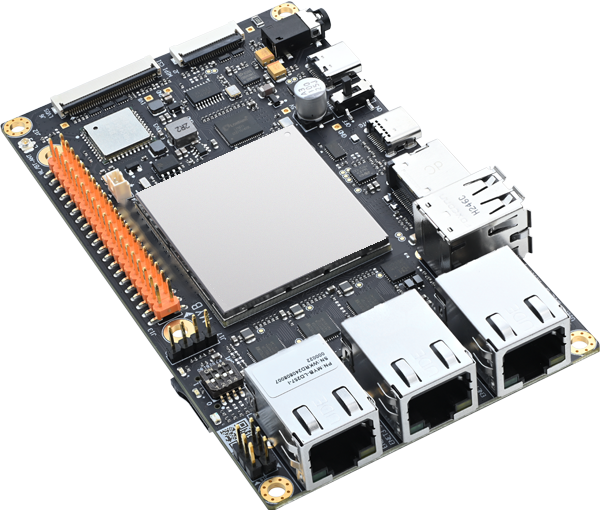
EM3-Lite is a compact EtherCAT motion controller that runs SE-Master, the Sodick EtherCAT Master, and the SA Motion library on a fanless 64-bit ARM board measuring just 120 × 70 mm. It controls up to 32 axes (8 interpolated) at a typical 1000 µs cycle, accepts a wide +5V/3A input and operates from −40 to +85 °C. Same master and same API as the rest of the KSMC®-ECAT family, on a smaller, more economical platform.
32 / 8
Axes / interpolated axes
1000 µs
Typical EtherCAT cycle time
2 ports
EtherCAT with cable redundancy
−40 to +85 °C
Operating range, +5V/3A input
Compact Hardware, Full EtherCAT Master
Everything a cost-sensitive machine needs to run a deterministic EtherCAT network and coordinated motion, on a board that clips onto a DIN rail.

System
- 2× 64-bit ARM Cortex-A35, ~1.5 GHz
- Real-time Linux
- Fanless, 120 × 70 mm, DIN-rail ready
- Wide +5V/3A input, −40 to +85 °C
- Gigabit Ethernet host link, USB, CAN, RS232/485
- Digital I/O, analog I/O and encoder interfaces

EtherCAT Master Features
- SE-Master, developed in-house by Sodick
- Cyclic PDO exchange with Distributed Clocks
- Cable redundancy across two EtherCAT ports
- ETG.1500 Class A feature set
- CoE, FoE, EoE and SoE mailbox protocols
- CiA 402 drive profile, any servo vendor

Motion Controller Capabilities
- Up to 32 motors, up to 8 interpolated axes
- Up to 4 coordinate systems, each with its own planner
- Jog, spline, CW/CCW arc, PVT, rapid and handwheel moves
- PID, disturbance observer, adaptive control, notch filters
- Sequential and periodic PLC scripting with macro variables
- Data gathering, plotting and gain tuning with RDI-L
Flexible Software Architecture: Buy Only the Layer You Need
Start with the EtherCAT master on its own, or add the SA Motion library on top. Because every KSMC-ECAT platform shares one C/C++ API, the application you write for EM3-Lite moves with you if the machine grows.
USE CASE #1
Build Your Own Application
SE-Master as a standalone EtherCAT master
Run your own control application on EM3-Lite and exchange process data with drives and I/O directly through the SE-Master API. You keep full ownership of the machine logic; EM3-Lite provides a deterministic, drive-vendor-agnostic EtherCAT network.
Ideal for: OEMs with an existing control application who need a compact, economical EtherCAT master.
USE CASE #2
High-Precision Motion Made Simple
SE-Master SA Motion library with RDI-L as a standalone EtherCAT master
Add SA Motion for interpolation, motion planning and servo tuning. The motion stack is not new: it has run Sodick’s own EDMs, machining centers and injection molding machines for twenty years. What is new is that it now speaks EtherCAT, on a board this size. RDI-L, the real-time debug tool, is part of every SA Motion deployment for parameter setting, gain tuning and data plotting.
Ideal for: Packaging, textile, printing and material handling machines with up to 8 interpolated axes.
USE CASE #3
Connect to the Plant
OPC-UA for SCADA and MES
Publish machine status and production data to SCADA, MES or IoT dashboards over OPC-UA, while the real-time core keeps the EtherCAT cycle and the motion loop deterministic.
Ideal for: Connected production lines and Industry 4.0 retrofits.
USE CASE #4
Scale Without Rewriting
One API across the KSMC-ECAT family
If a future machine needs an IEC 61131-3 PLC, G-code execution or a faster cycle, move up to EM3, EM4-Lite or EM4. The SE-Master API stays the same, so your application moves with you instead of starting over.
Ideal for: Machine builders with a product range that spans entry-level and high-end models.
EM3-Lite Technical Specifications
| Processor | 2× 64-bit ARM Cortex-A35, ~1.5 GHz |
| EtherCAT master | SE-Master (software) |
| Real-time OS | RT-Linux |
| Axes | Up to 32 axes / 8 interpolated |
| EtherCAT cycle time | 1000 µs (typical) |
| EtherCAT ports | 2, with cable redundancy |
| I/O interfaces | EtherCAT, GPIO, Isolated CAN interface, Isolated RS485 interface, RS232 interface |
| Connectivity | Gigabit Ethernet (host / PC link), USB, CAN, RS232/485 |
| Software | SE-Master, SA Motion, RDI-L, OPC-UA |
| Dimensions | 120 × 70 mm, DIN-rail mount |
| Cooling | Fanless |
| Operating temperature | −40 to +85 °C |
| Power supply | +5V/3A |
Typical Applications for EM3-Lite
Packaging machinery
Coordinated feeds, registration and indexing
Textile machinery
Multi-motor synchronization in hot, dusty panels
Printing machines
Web handling and synchronized rollers
Material handling
Conveyors, pick-and-place and transfer axes
Robotics
Compact multi-axis cells and gantries
Semiconductor equipment
Deterministic positioning stages
Measurement systems
Repeatable motion for inspection and test
FMCG lines
Cost-driven, high-volume production equipment
EM3-Lite vs EM3: Which Embedded Controller Fits?
Both are board-level controllers you design into the machine, with no PC and no fan. The choice comes down to cycle time, software and environment.
| EM3-Lite | EM3 | |
| Processor | 2× 64-bit ARM Cortex-A35 | 2× ARM Cortex-A9 (SoC FPGA) |
| EtherCAT master | SE-Master (software) on RT-Linux | FPGA-based SE-Master on FreeRTOS |
| Cycle time | 1000 µs typical | 125 µs minimum, at 32 drives |
| Axes | Up to 32 / 8 interpolated | Up to 32 motors / 8 interpolated |
| EtherCAT ports | 2, cable redundancy | 2, cable redundancy |
| Software | SA Motion, RDI-L, OPC-UA | SA Motion, IEC 61131-3 PLC, user app, OPC-UA |
| Power and environment | +5V/3A, −40 to +85 °C, DIN-rail | 24 VDC, customizable base board |
| Best for | Cost- and size-sensitive builds | Lowest jitter, OEM custom base board |
Fully Tested EtherCAT Devices
The following devices have been fully tested with the EM3-Lite EtherCAT master. Because SE-Master supports the CiA 402 drive profile, other CiA 402 EtherCAT drives can also be used.
| Manufacturer | Model | Type |
|---|---|---|
 | MADHT1105B01 | Servo drive |
 | SGD7S | Servo drive |
 | R88D-KNA5L | Servo drive |
| NXECC202 | IO Coupler |
| ID4342 | IO Unit |
| OD4121 | IO Unit |
 | RYT401S7-VCS2 | Servo drive |
 | EL7-EC400F | Servo drive |
 | FV3S-R3-NA2R8 | Servo drive |
 | EK1100 | IO Coupler |
| EL1004 | IO Unit |
| EL3001 | IO Unit |
| EL4001 | IO Unit |
| EL2004 | IO Unit |
More fully tested devices to come. If you have questions about the compatibility of any component, please contact us.
Frequently Asked Questions About EM3-Lite
What is the EM3-Lite EtherCAT motion controller?
EM3-Lite is a compact, fanless embedded controller from Sodick America's KSMC-ECAT family. It runs SE-Master, and the SA Motion library on a dual-core 64-bit ARM processor under real-time Linux. It controls up to 32 axes (8 interpolated) at a typical 1000 µs cycle, has two EtherCAT ports with cable redundancy, mounts on a DIN rail and runs from between −40 and +85 °C.
How is EM3-Lite different from EM3?
EM3 runs an FPGA-based EtherCAT master on an ARM Cortex-A9 system-on-chip and reaches a 125 µs cycle at 32 drives, with an IEC 61131-3 PLC and a customizable base board. EM3-Lite runs SE-Master in software on a 64-bit ARM Cortex-A35 under RT-Linux with a 1000 µs typical cycle. In exchange, it is smaller, DIN-rail ready, accepts and operates from −40 to +85 °C. Both share the same API.
Is a 1000 µs cycle time fast enough for my machine?
For many machines, yes. A 1 ms typical cycle is comfortable for packaging, textile, printing and material handling equipment. CiA 402 servo drives close their own current, velocity and position loops internally, so the EtherCAT cycle sets how often new setpoints arrive, not the drive's servo bandwidth. If your process needs faster setpoint updates, EM3 reaches 125 µs at 32 drives, and EM4 offers a best-case 62.5 µs PDO cycle.
Does EM3-Lite include a PLC or G-code (NC) functionality?
No. EM3-Lite does not run the IEC 61131-3 PLC runtime or the MaCH NC (G-code) executor. SA Motion includes sequential and periodic PLC scripting for machine sequencing, which covers many motion-centric machines. If you need IEC 61131-3 on the same board, choose EM3, EM4-Lite or EM4. For G-code execution, choose EM4-Lite or EM4.
Which servo drives and I/O modules work with EM3-Lite?
EM3-Lite is drive-vendor agnostic. SE-Master supports the CiA 402 drive profile, so any CiA 402 EtherCAT servo drive can be used, from any vendor and in any mix, along with standard EtherCAT I/O couplers and terminals. Device descriptions are imported from ESI files with the EtherCAT configurator. Contact us to confirm a specific drive or I/O module.
Why does EM3-Lite have Gigabit Ethernet if EtherCAT runs at 100 Mbit/s?
They are two different links. The Gigabit Ethernet port is the host connection, used to reach EM3-Lite from a development or operator PC for RDI-L, your HMI or OPC-UA. The two EtherCAT ports are separate and run at 100 Mbit/s, as the EtherCAT standard specifies. EtherCAT gets its performance from processing frames on the fly, not from raw link speed.
Can I buy EM3-Lite as just an EtherCAT master?
Yes. You can buy EM3-Lite with SE-Master only and have your own application exchange process data with drives and I/O directly, or add the SA Motion library (with RDI-L) for interpolation, planning and tuning. OPC-UA is available in either configuration. Commercial terms are set per project; tell us your axis count, cycle time and annual volume for a recommendation.
EM3-Lite is a compact, fanless embedded controller from Sodick America’s KSMC-ECAT family. It runs SE-Master, and the SA Motion library on a dual-core 64-bit ARM processor under real-time Linux. It controls up to 32 axes (8 interpolated) at a typical 1000 µs cycle, has two EtherCAT ports with cable redundancy, mounts on a DIN rail and runs from between −40 and +85 °C.
EM3 runs an FPGA-based EtherCAT master on an ARM Cortex-A9 system-on-chip and reaches a 125 µs cycle at 32 drives, with an IEC 61131-3 PLC and a customizable base board. EM3-Lite runs SE-Master in software on a 64-bit ARM Cortex-A35 under RT-Linux with a 1000 µs typical cycle. In exchange, it is smaller, DIN-rail ready, accepts and operates from −40 to +85 °C. Both share the same API.
For many machines, yes. A 1 ms typical cycle is comfortable for packaging, textile, printing and material handling equipment. CiA 402 servo drives close their own current, velocity and position loops internally, so the EtherCAT cycle sets how often new setpoints arrive, not the drive’s servo bandwidth. If your process needs faster setpoint updates, EM3 reaches 125 µs at 32 drives, and EM4 offers a best-case 62.5 µs PDO cycle.
No. EM3-Lite does not run the IEC 61131-3 PLC runtime or the MaCH NC (G-code) executor. SA Motion includes sequential and periodic PLC scripting for machine sequencing, which covers many motion-centric machines. If you need IEC 61131-3 on the same board, choose EM3, EM4-Lite or EM4. For G-code execution, choose EM4-Lite or EM4.
EM3-Lite is drive-vendor agnostic. SE-Master supports the CiA 402 drive profile, so any CiA 402 EtherCAT servo drive can be used, from any vendor and in any mix, along with standard EtherCAT I/O couplers and terminals. Device descriptions are imported from ESI files with the EtherCAT configurator. Contact us to confirm a specific drive or I/O module.
They are two different links. The Gigabit Ethernet port is the host connection, used to reach EM3-Lite from a development or operator PC for RDI-L, your HMI or OPC-UA. The two EtherCAT ports are separate and run at 100 Mbit/s, as the EtherCAT standard specifies. EtherCAT gets its performance from processing frames on the fly, not from raw link speed.
Yes. You can buy EM3-Lite with SE-Master only and have your own application exchange process data with drives and I/O directly, or add the SA Motion library (with RDI-L) for interpolation, planning and tuning. OPC-UA is available in either configuration. Commercial terms are set per project; tell us your axis count, cycle time and annual volume for a recommendation.
Let Us Size One of Your Machines
No one designs in a controller from a slide deck. Send us a few details and our engineers will come back with a platform recommendation, a software bundle and a quotation for your volume.
- Number of axes, and how many are interpolated
- Required cycle time
- Drive and I/O vendors you use
- Annual machine volume